The 12-Step Rule: Why Length Predicts Documentation Failure
Almost every documentation team writes longer guides than they should. Length compounds against you, and 12 steps is the working ceiling above which reader engagement collapses.

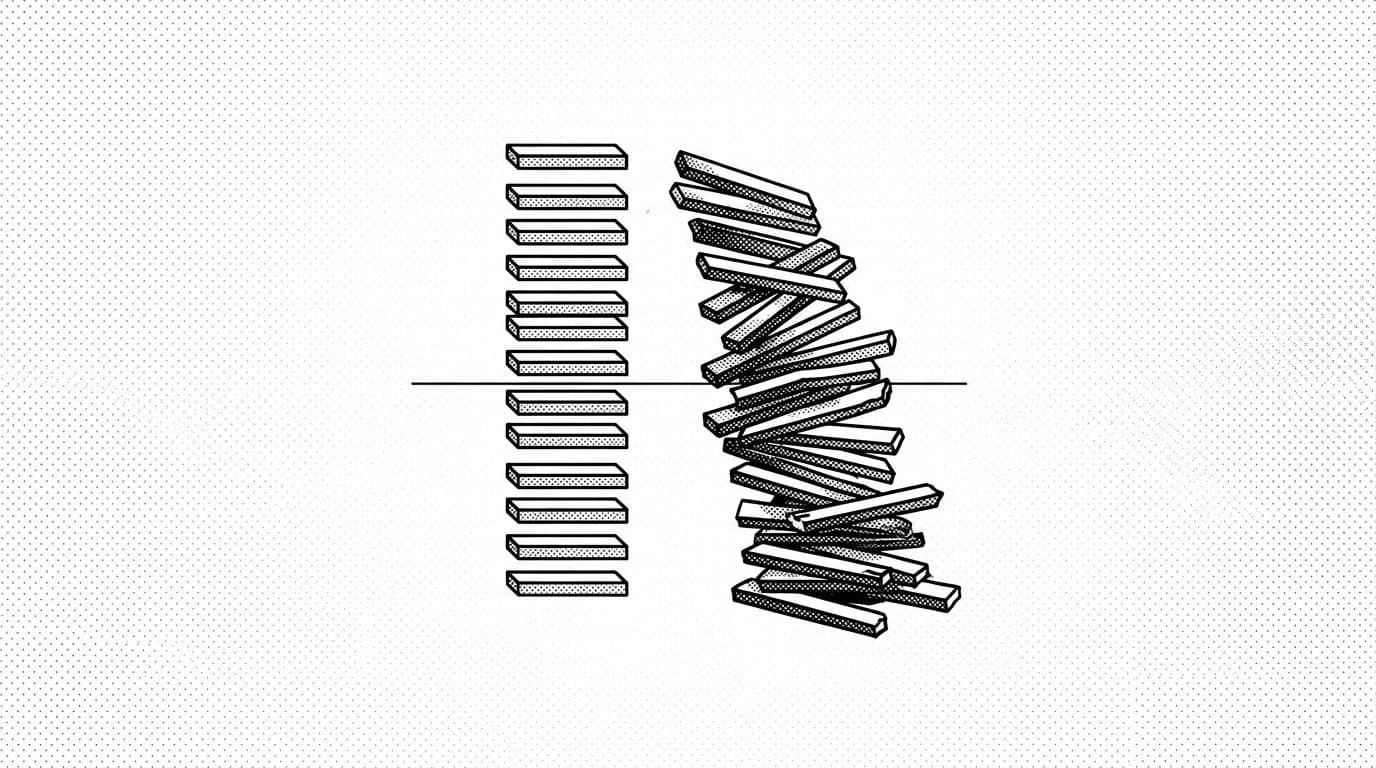
- 12-step CS guide self-serve completion
- 88%
- 25-step doc engagement
- Drops steeply
- Refresh per affected step
- 2 min
- Editing pass for 12-step guide
- 30 min
The short version.
A documented workflow over 12 steps loses readers faster than the team that wrote it expects. Across customer success, IT operations, internal SOPs, and engineering onboarding, the same pattern shows up: the guide that hits completion is edited down, not recorded long. The editing instinct decides whether a guide gets used at month four. This is a framework, with five compression techniques and one ceiling.
Why 12 steps is the right ceiling
Twelve steps is the ceiling because attention degrades faster than authors think. NNGroup's research on why web users scan instead of reading shows readers do not consume documentation linearly. They scan. They fixate on the first words of each block. They skip prose that does not answer in the first sentence. Past a certain length, the scan stops returning anything useful and the reader leaves.
The number 12 is not arbitrary. It is the working ceiling across four very different contexts that share one property: the reader is busy and the guide competes with asking a colleague. A senior CSM at a mid-market B2B SaaS shipped a 12-step onboarding guide a Pleo customer reads in twelve minutes at 88% completion. An IT operations lead at a 220-person scale-up turned the top twenty repeat tickets into 20 short guides, each sized so a Tier 1 question resolves in six minutes of reading. A B2B fintech rebuilt its 21-SOP audit library in six weeks, each SOP sized for one owner. A staff engineer at a Series B observability platform replaced a 2,400-line README with twelve guides covering the dev environment.
The ceiling holds because of how reading attention behaves on screen. NNGroup's work on the F-shaped pattern of reading web content describes a horizontal-then-vertical scan that loses density past the first half of a long page. A 12-step guide stays inside the F. A 25-step guide drops most readers below the fold of the second pass. The ceiling is about how far down the page a busy reader will keep paying attention before pinging someone in Slack.
Treat 12 as the ceiling, and the editorial work that follows is compression, not expansion.
What length actually predicts
Length predicts reader follow-through more reliably than almost any other variable. Across the four cases above, the teams shipping 12-step or shorter guides saw self-serve completion in the 80% range based on customer-reported engagement patterns. Guides over 20 steps consistently get split, archived, or rewritten because the second half is not being acted on.
The pattern lines up across roles. Susan, the senior CSM, watched her 12-step onboarding guide finish at ~88% of new customers before the optional Zoom (self-reported by the CSM team). Trevor, the IT lead at the 220-person scale-up, found his library of twenty short guides covered 70% of historical Tier 1 volume because each guide was short enough to be tried before opening a ticket (measured against pre-library ticket volume). NNGroup's legibility, readability, and comprehension research is direct: longer prose lowers comprehension, and reference content reads worse than narrative of the same length. Documentation is reference content under time pressure. The penalty stacks.
The table below lines up rough engagement expectations by length, drawn from NNGroup's reading-attention research and customer-reported library patterns.
| Steps in guide | Typical engagement | What happens at the bottom |
|---|---|---|
| 5 to 8 | Very high | Reader finishes, may re-skim |
| 9 to 12 | High | Reader finishes, occasionally pings on edge case |
| 13 to 18 | Moderate | Drop-off appears in the last third |
| 19 to 25 | Low | Reader skims to end, does not act on later steps |
| 26+ | Very low | Reader gives up or splits the task into a Slack DM |
Engagement drops past 12 not because the work is harder, but because the reader's attention runs out. If your guide is 25 steps and the second half contains the part that prevents an outage, you will pay for that length in tickets. The fix is to ship a shorter guide. A workflow audit usually finds that a recording-first method cuts step counts by 40% to 60% in the editing pass alone.
Five compression techniques
Compression is editorial work, not subtraction. Same outcome, fewer steps. Five techniques cover most cuts on a 25-step draft.
1. Collapse setup steps that share a screen. A draft often has "Open Settings", "Click General", "Scroll to Profile", "Click Edit" as four steps. They are one step: "Open the General settings panel and click Edit on Profile." This move alone removes three to five steps.
2. Move conditional branches out of the main path. A guide that lists three auth options inline has tripled itself. Pull branches into linked sub-guides. The 20-guide IT helpdesk library works this way: each known failure mode is its own short guide, linked from the main one.
3. Cut every "as you can see" and "now we are going to". First-cut narration is full of filler that adds steps without adding information. Loom and unedited recordings keep this filler by default. Scribe and Tango auto-detect step boundaries but still leave verbal padding. The editor pass tightens "Now click on the green button at the top right" to "Click Save (top right)." A good pass takes thirty minutes and cuts about a third of the wordcount.
4. Replace prose with screen evidence. A sentence describing a screen is the wrong unit. The screenshot is the proof. Drop the prose, keep the screenshot, label what to click. NNGroup's research on the F-shaped pattern of reading web content is direct that scannable structure beats narrative for reference content.
5. Stop documenting what the UI already says. A button labelled "Save" does not need a step that says "Click Save to save your work." Document only what is not obvious: the reasoning, the order, the consequence. Keep the Chrome extension capture flow tight by giving each step one job.
A 25-step draft cut with these five techniques usually lands at 11 to 14 steps. If you are still over 14, the workflow itself probably needs splitting.
When to break a guide into two
Break a guide into two when compression has failed and the workflow contains two genuinely different jobs. The signal is structural. If steps 1 to 8 set up the system and steps 9 to 22 use it, those are two guides. The reader of the second rarely needs the first.
Susan's case is the cleanest example. The original walkthrough was a 45-minute Zoom covering workspace setup, project templates, integrations, and three edge cases. The first compression pass got it to 18 steps. The second pass split it into one 12-step onboarding guide for the standard path and three short branch guides for the edge cases. Most customers never open the branches. The ones who need them get a focused answer instead of a buried section.
The same pattern shows up in the audit-ready SOC 2 SOP library. Twenty-one SOPs, each sized for one process. Reconciliation, KYC review, and churn investigation are three different jobs and three different SOPs. A 60-step "Operations Handbook" would have failed audit because nobody, including the auditor, would read it end to end. One owner, one SOP, one short guide. The same logic applies under UK GDPR and ICO scrutiny: an auditor reviewing a data-subject-access procedure wants the SOP for that one process, not a chapter buried inside a thirty-page operations document.
The decision rule for splitting is straightforward.
| Signal | Action |
|---|---|
| One audience, one tool, under 14 steps | Keep as one guide |
| One audience, one tool, 15 to 22 steps | Compress with the five techniques first |
| Two audiences (reader of step 1 is not the reader of step 18) | Split into two |
| One audience but two tools or two times of day | Split into two |
| 25+ steps after compression | Workflow is the problem, redesign before documenting |
Tooling does not change the rule. G2's reviews of Scribe and Tango consistently flag long auto-generated guides as the most common reason customers archive a tool. Length is the failure mode the tools cannot fix on their own.
How to keep the editing instinct
Keep the editing instinct by making compression a step in the workflow, not an afterthought. Most teams skip the editing pass because recording is the visible work and the cut is the invisible one. The fix is a named cadence that puts editing on the calendar.
Three patterns hold the line at 12 steps over time.
Per-guide step ceiling. Set 12 as a default ceiling in the team's documentation standard. New guides over 12 steps go through a compression review. The review takes thirty minutes and uses the five techniques above. Helen, the staff engineer who built the first guide in the 12-guide engineering library at the Series B observability platform, held this rule because she insisted on it for the next eleven.
Step-level update only. When the product changes, re-record the affected step, not the whole guide. A two-minute step update preserves the editing investment. A full re-record drifts back toward longer drafts because the editing pass gets skipped under deadline. The 21-SOP fintech library survives quarterly because owners update single steps, never whole SOPs. When the GoCardless webhook signature scheme changed, one owner re-recorded a single step in two minutes and the SOP held.
Quarterly compression audit. Every quarter, the owner opens the guide and asks "is this still 12 steps?" If not, half an hour of compression resets the count. The alternative is a doc sprint every six months that costs a week and produces a guide nobody trusts.
If you want the 12-minute onboarding pattern Susan walks through, the Team plan starts at $12 USD per seat per month (or $10 USD on annual, roughly £8 at current rates) and includes AI step rewriting, multi-language, and step-level edit on every tier. The tool matters less than the discipline.
The editing instinct is the one capability that compounds. Recording skill levels off after the third take. Editing gets sharper with every guide you cut. A team that treats compression as the work, and recording as the input, ends up with a library that stays under 12 steps and stays read.
Frequently asked questions.
- What about complex workflows that genuinely need 30 steps?
They almost never do. A 30-step workflow is usually two or three workflows stacked together. The five techniques typically cut a 30-step draft to 12 to 14. The 21-SOP fintech library is the proof: even regulated finance processes audited under SOC 2 and reviewed against UK GDPR fit inside a per-SOP ceiling under 15 steps when each SOP covers one process.
- Is 12 a hard ceiling?
It is a working ceiling, not a hard rule. Completion drops sharply between 12 and 18 steps and falls below 50% past 25. Treat 12 as the default target and 14 as the trigger for a compression review. Ship guides above 14 only after the five techniques have been applied and the length is confirmed structural.
- What is the research behind it?
Two strands. NNGroup has decades of work on scan-first reading, the F-shaped fixation pattern, and engagement drop-off as length grows. Customer-reported engagement patterns across the four libraries above (CS, IT, SOC 2 SOPs, engineering) line up with the same curve: follow-through stays high to about 12 steps, weakens in the 13 to 18 range, and falls off past 25.
- Does this apply to video as well as written guides?
Yes, more sharply. Loom analytics on raw 45-minute recordings rarely show completion above 30%. The same content cut to a 12-step guide with screenshots and short narration finishes at 80% to 90%. The editing instinct matters more for video, not less.
- How do I get a team to compress when they want to be thorough?
Put the data in front of them. Pull the support questions still coming in on a long guide. If question after question maps to a step in the second half, that is evidence the second half is not being read - it is being skipped. Compression stops feeling like cutting useful content once the team sees the bottom half was unread anyway.
Ready to ship guides that stay under the 12-step ceiling?
Capture turns a recording into a step-list in a few minutes, then makes the editing pass fast: collapse, cut, re-record one step at a time. Free Chrome extension, no signup.
The Case for Step-by-Step Guides: Six Teams, One Pattern
The senior person who knows a workflow cold becomes a bottleneck. The wiki rots. The Loom nobody watches accumulates dust. Step-by-step guides break that pattern across the six teams we have watched do this in production.
How to Document a Customer Onboarding Workflow in 2026
Most onboarding documentation goes stale in eight weeks because nobody re-records it when the UI ships an update. The fix is not better writers. It is a recording-first method that takes ten minutes per refresh.
SOC 2 Audit-Ready SOPs Without a Documentation Sprint
A SOC 2 auditor does not want pretty Notion pages. They want proof a control was executed. Owner-recorded guides with timestamped clicks are the cleanest evidence most auditors see all year.
Record one workflow.
Free Chrome extension. No signup required.